After Years Treating Chronic Reflux, I Stopped Recommending Antacids First. Here's What I Tell Patients Now.
Most heartburn isn't a problem of too much acid. It's a problem of a worn-down protective barrier — and that single distinction changes everything about how it should be treated.

In my years of clinical practice, I've watched the same pattern repeat in patient after patient. They arrive already taking something — an antacid, an over-the-counter acid reducer, often a prescription acid blocker. It worked at first. Then it stopped. So they took more. By the time they're sitting across from me, they're frustrated and asking the same question: why does nothing hold?
For a long time, the standard answer was straightforward — suppress the acid. And for acute, short-term cases, that approach still has its place. But something never sat right with me. So many of my patients on long-term acid suppression weren't getting better. Some were quietly getting worse. That doesn't happen if acid is the whole story.
The explanation, when I finally connected it, had very little to do with how much acid a patient was producing — and almost everything to do with what was supposed to be protecting them from it.
It's a distinction that sounds academic until you understand what it means in practice. If you've been doing everything "right" — watching your diet, taking your medication, sleeping propped up — and the burn keeps returning, this is almost certainly the piece no one has explained to you.
The "Barrier Gap"
Why the same amount of acid that never bothered you at 35 can start to burn at 50.
Your stomach is supposed to be acidic — that's normal and necessary for digestion. What protects the tissue from that acid is a continuously produced layer of mucus, what clinicians call the mucosal defense barrier, coating the stomach lining and the lower esophagus. In a healthy gut, it neutralizes and blocks acid before it ever reaches raw tissue.
With age, chronic stress, certain foods, and — notably — prolonged acid-suppressing medication, that barrier thins. The acid hasn't increased. The protection has decreased. The result is direct contact between acid and unprotected tissue. Clinically, that's compromised mucosal defense. With patients, I call it the Barrier Gap — and it's why suppressing acid so often feels like bailing a leaking boat instead of patching the hole.
Once you see reflux through this lens, the pattern in my exam room makes sense. The chewables, the acid blockers, the elevated pillows — every one of them targets the acid. Not one of them does anything to restore the barrier.
"I'd taken acid reducers for almost a decade and assumed this was just my life now. Three weeks in, I slept flat on my back for the first time in years. I didn't expect a gummy to do what the prescriptions couldn't."
Why the Standard Approaches Fall Short
Once you understand the Barrier Gap, the entire treatment shelf looks different.
Antacids neutralize acid for an hour or two. Genuinely useful for acute symptoms — but they have no effect on the lining, so the burn returns as soon as they wear off.
Acid blockers (H2 blockers and proton-pump inhibitors) reduce acid production. They have an important role in true acid-driven disease. But the stomach needs acid to digest food and absorb nutrients, and the research on prolonged suppression is sobering: it does nothing to restore the protective barrier, and stopping can trigger a rebound. For many patients, that's how you end up needing more over time, not less.
Lifestyle measures — smaller meals, not eating late, elevating the head of the bed — genuinely reduce how often acid refluxes upward. I recommend them. But if the barrier is thin, even normal, well-behaved acid still irritates the tissue.
This is the part that matters: every therapy that targets only the acid leaves the barrier exactly where it was — sometimes thinner. For a patient with compromised mucosal defense, that's precisely why "managing" reflux for years so rarely resolves it.
So in my own practice, the question shifted. It stopped being "how do we suppress more acid?" and became "how do we help the body restore that protective layer?" And on that question, one compound has far more behind it than any other.
The One Compound I Reach For First: DGL
If I had to point to a single ingredient with a meaningful track record for supporting the barrier rather than just the acid, it's DGL — deglycyrrhizinated licorice. It isn't new, and it isn't exotic. It's one of the most quietly well-regarded compounds in functional gastroenterology, and most patients have simply never heard of it.
What it actually is
Licorice root (Glycyrrhiza glabra) has been used for digestive complaints for well over a thousand years. The problem with whole licorice is a compound called glycyrrhizin — it can raise blood pressure and deplete potassium, which makes regular use a poor idea. DGL is licorice with that compound removed. You keep what's useful for the gut and discard what's risky for the heart. That's the entire point of the "deglycyrrhizinated" label, and it's why I'm comfortable with it where I'd never suggest plain licorice.
Why it fits the Barrier Gap specifically
This is what sets DGL apart from anything in the antacid aisle. Rather than neutralizing or suppressing acid, DGL is thought to support the stomach's own production of protective mucus — the very mucosal layer that thins in the Barrier Gap. In plain terms: it works with the body's natural defenses instead of overriding the system. It addresses the coating, not just what lands on it.
Why dose and consistency are where DGL usually fails
Here's the practical problem I've watched defeat DGL for years. It works best taken consistently, before meals — and the traditional form is a large, chalky, bitter tablet you're meant to chew. Almost nobody keeps that up. Adherence collapses within a week or two, and then patients conclude "it didn't work," when in reality they never gave it a fair, consistent run. The compound was never the issue. The format was. That single point — getting a real dose of DGL into a form people will actually take every day — is the whole reason the product below exists.
What People Report Back
*Illustrative placeholders — replace with verified internal data before this page goes live.
"I was the most skeptical person alive. I'd wasted so much money. But I'm on my third pouch and I haven't reached for a single antacid in over a month. That's the part I still can't believe."
"My husband noticed before I did — he said I stopped doing the 'midnight pace around the kitchen' thing. He was right. I'd just gotten so used to it I didn't realize it stopped."
What to Expect — and When
I want to set honest expectations, because this is not an antacid and it doesn't pretend to be. It's not an instant off-switch. It's a rebuild. Here's roughly how it went for me and what I've seen others describe:
Days 1–7
You're building a routine. Some people feel a little soothing early; many feel nothing dramatic yet. This is the patience window — keep going.
Weeks 2–3
The most common turning point. The nights start getting quieter. You reach for the chewables less out of habit than need.
Weeks 4–8
This is where people tend to say "wait, when did this stop?" The goal isn't masking the burn — it's not having to think about it.
So What Are Your Actual Options?
Strip away the noise and there are really only three paths from here:
The Form I Now Point Patients Toward
I'm cautious about naming products — it's not the habit of most physicians, and it shouldn't be. But patients ask me directly what to take, and the honest answer is the one that solves the adherence problem. It's called Belly Beans: a meaningful 400mg daily dose of DGL in gummy form. Not a stack of fillers — just the one compound with a real track record, in the one format people actually stay consistent with.
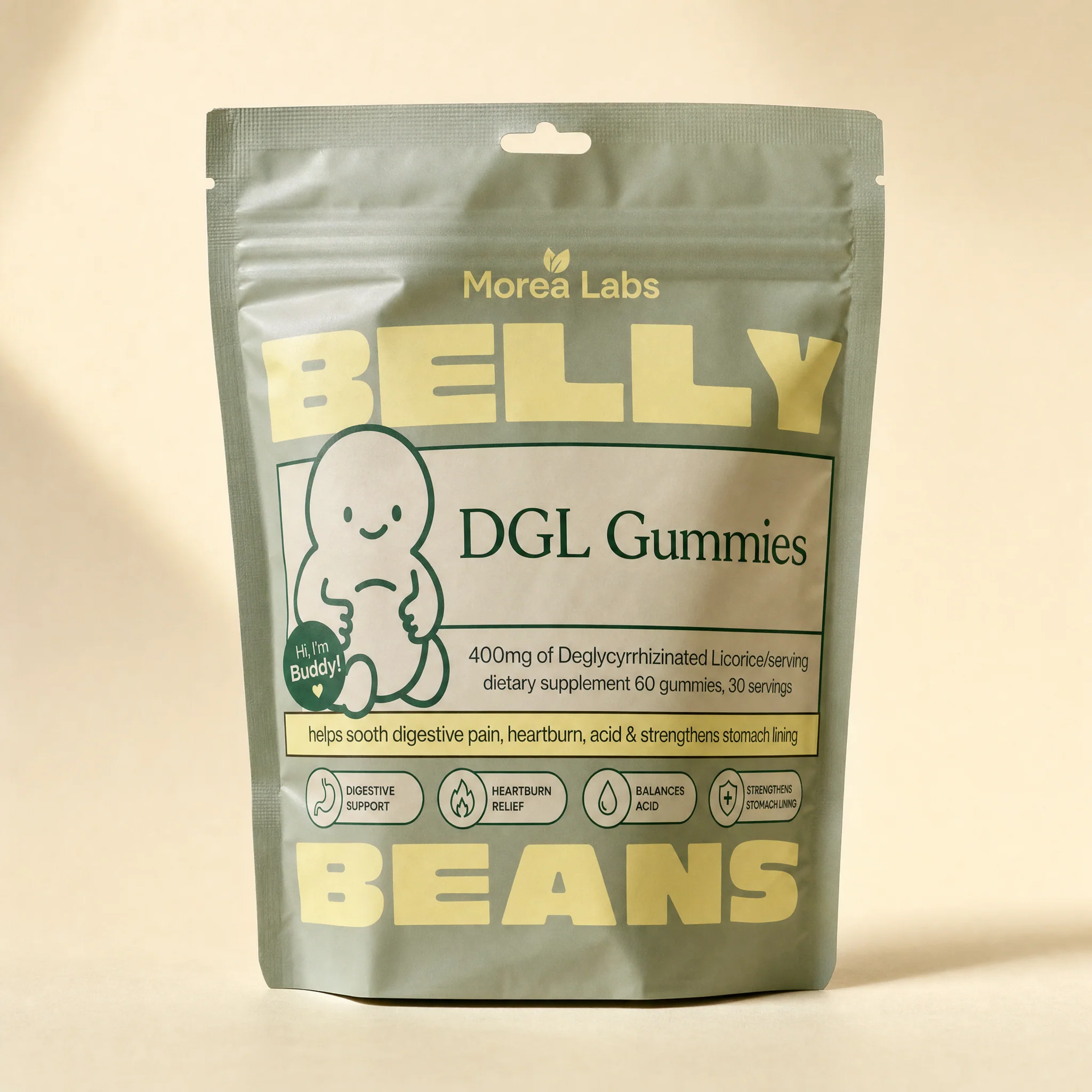
One honest caveat I give every patient: this is not an antacid and it won't behave like one. If you need to stop an acute burn in ten minutes, an antacid still wins. Belly Beans is for the person who is tired of the burn returning and is ready to support the barrier underneath it — consistently, the way DGL is meant to be taken.
What I want every reflux patient to understand
If you've been managing the acid for years and the burn keeps returning, you're very likely not doing anything wrong — you may simply have been given the wrong target. Stop bailing the boat. Support the barrier underneath it. That single shift in thinking is the one I've seen change the most patients' lives, and it costs nothing to reconsider.